
THE QUESTION, ANSWERED
WHAT IS THE ANTIVIRUS FOR AI?
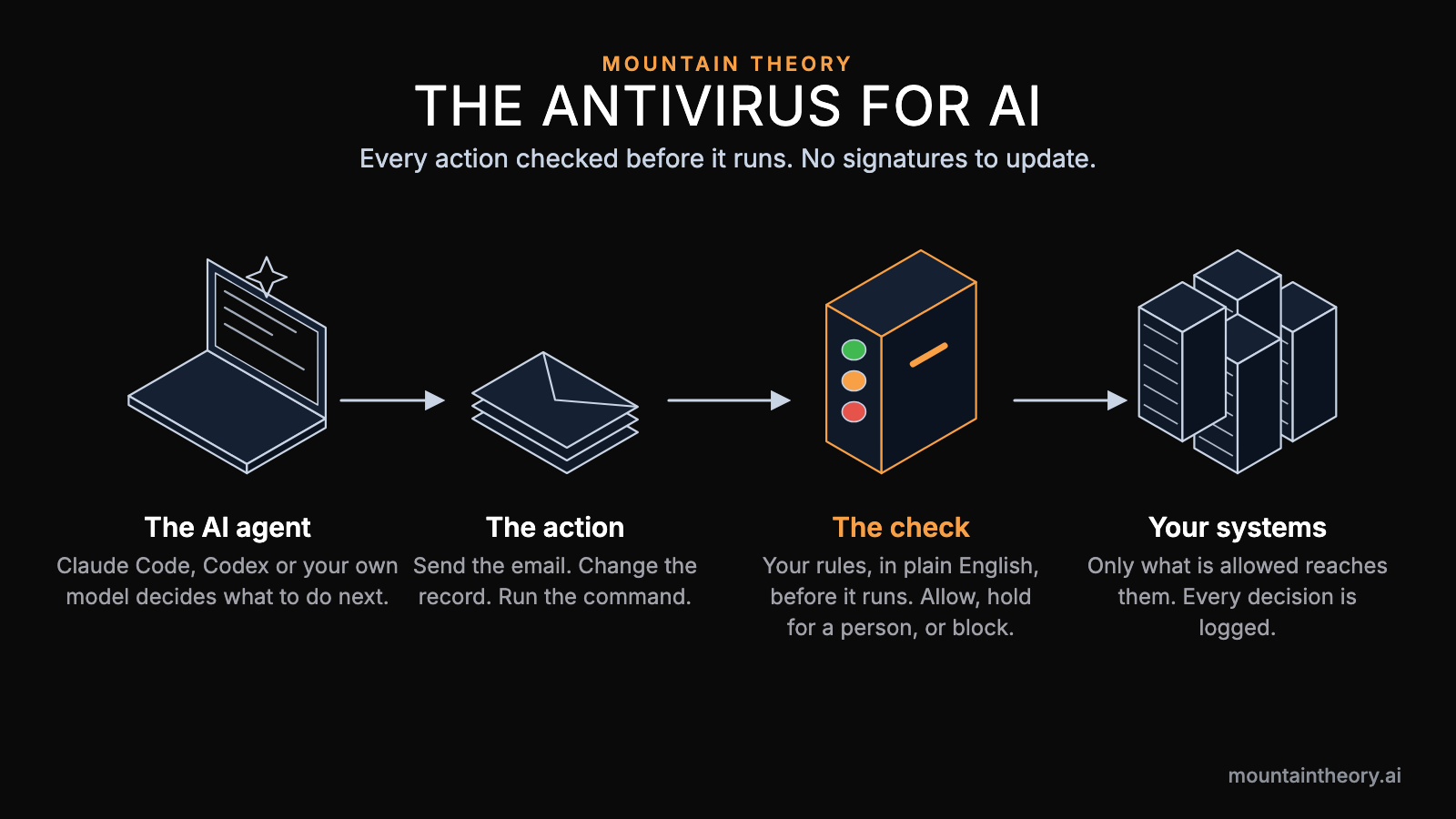
The antivirus for AI is a control that sits wherever an AI agent acts and checks each action before it runs. Safe actions go through. Risky ones wait for a person. Dangerous ones are blocked. Unlike antivirus, it does not match signatures, because an AI agent’s next bad idea has never been seen before.
Watch it in 76 seconds: Mike May, CEO, on what the antivirus for AI does.
Read the full analysis: why antivirus stopped keeping up, and what the antivirus for AI has to do instead.
Why the comparison works
Antivirus earned its place by being on every machine and stopping bad code before it ran. Nobody asked whether the file was well-intentioned. It checked, then it decided.
AI agents now run on laptops, servers and in the cloud. They read records, send email, run commands and change settings, with real credentials. Most companies have nothing that checks those actions first.
Where the comparison breaks
Classic antivirus works from a list of known bad things. That stopped keeping up years ago, and AI makes it worse: an agent can find a new way to do damage on its first try, with no attacker involved. A list cannot hold what has not happened yet. What that looked like in a recorded run.
So the antivirus for AI checks the action itself against rules you write in plain English. It does not need to have seen the behavior before. No signatures to update.
What it has to do
- Check every action before it runs, not after.
- Allow it, hold it for a person, or block it.
- Stop the workaround when an agent tries another path to the same blocked action.
- Catch an agent that drifts off the task it was given. What drift is.
- Keep personal data from leaving.
- Log every decision so you can show your auditor what your AI did. What that record has to contain.
Where it has to install
Anywhere an AI acts. A coding agent on a laptop. An agent on a server. A model in your own environment or in the cloud.
Developer tools and enterprise control
Some tools now describe themselves as antivirus for AI agents on a developer’s machine. That is useful. An enterprise needs more on top: one set of rules across every agent, a person in the loop for the actions that need one, and a record an auditor will accept.
Where Mountain Theory fits
Mountain Theory is the antivirus for AI. It checks every action before it runs. No signatures to update.
It works with 158 AI systems today, from Claude Code and OpenAI Codex on a laptop to small models at the edge, in your environment or the cloud. The full list. Every published test, misses included, is at the proof page. The category is AI Infrastructure Defense.
Common questions
Is there antivirus for AI?
Yes. Controls now exist that check an AI agent’s actions before they run, the way antivirus checks a file before it opens.
Does antivirus protect against AI agents?
Not on its own. Antivirus looks for known malicious code. An AI agent with valid credentials taking a harmful action is not malicious code.
What is the difference between antivirus and the antivirus for AI?
Antivirus matches known bad files. The antivirus for AI checks each action against your rules, so it can stop behavior nobody has seen before.
More answers
The product, if you want it
Mountain Theory is the check described above, shipped. It works with any AI you already use, in your environment or the cloud.