 ™
DEFINITION
WHAT IS AI INFRASTRUCTURE DEFENSE?
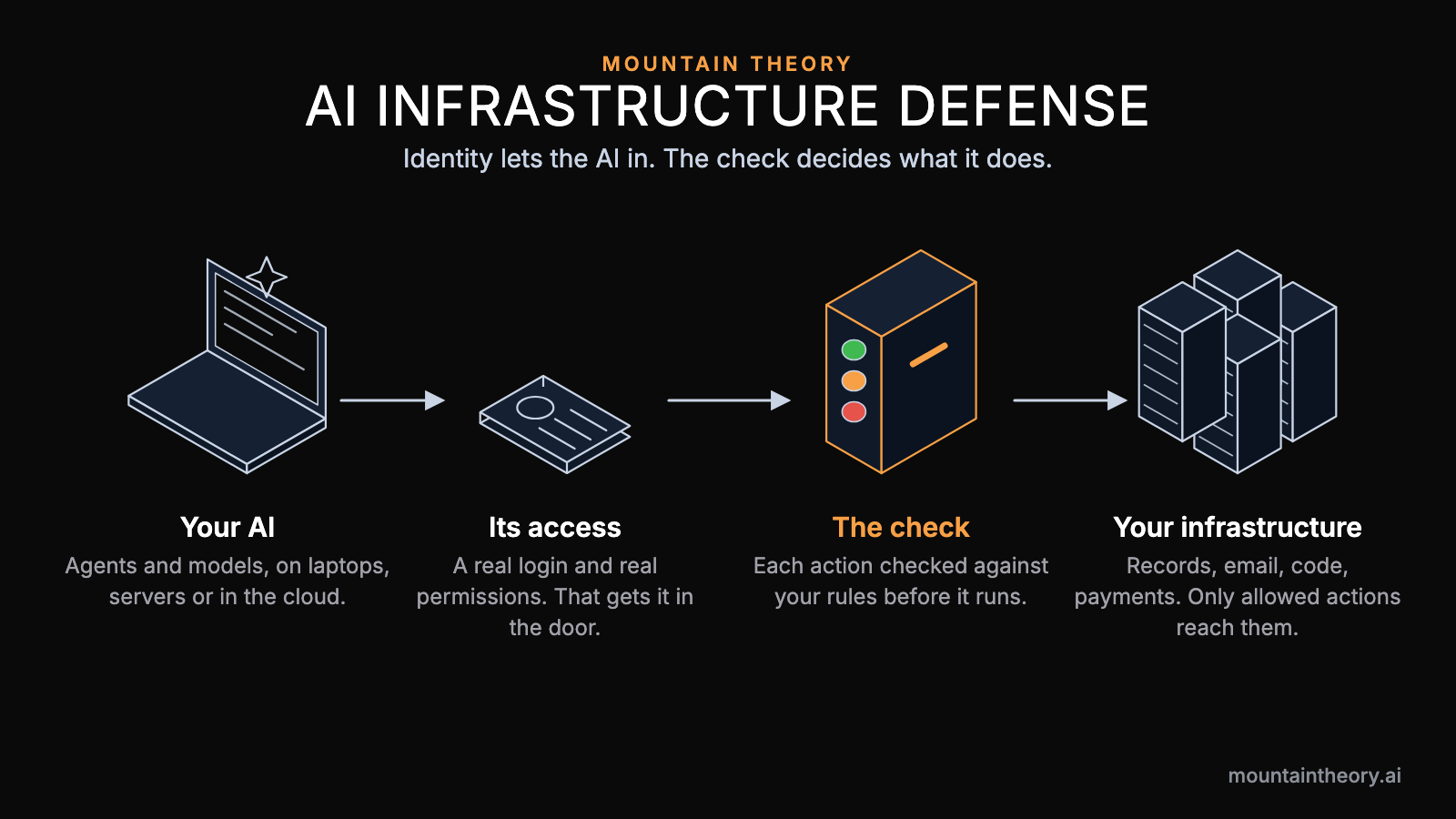
AI infrastructure defense is security for the moment an AI system acts, not the moment it thinks. It sits between the AI’s decision and the action that decision would trigger. Each proposed action is checked against your policy before it reaches the system it would touch. Mountain Theory builds AI infrastructure defense for enterprises.
What we do
What Mountain Theory does
What it protects
The AI your business actually runs: agents, agent harnesses, assistants, copilots and automated workflows, whoever built them and whatever model drives them. See everything Mountain Theory can govern →
How it works, in one line each
Each action returns one of three outcomes: ALLOW, HOLD, or BLOCK. Rules are written in plain English, not code. It runs autonomously: no human sits in the loop unless your policy asks for one, and HOLD is a choice you switch on, not a toll you pay. The system learns from every decision it makes. Each decision is written down: who, what, when, why.
Where it operates
At the execution layer: the moment between an AI deciding and an AI doing. The decision can be brilliant, fooled, or simply wrong. Either way, the action gets checked against your rules before it becomes real.
The proof
Tests you can watch, rather than claims: novel agent behavior stopped the day it appeared, with no rule update, no signature and no retraining, including more than 140 attempts stopped in a single run; and the same 10 actions run against NVIDIA OpenShell in three configurations, on camera. Compare Mountain Theory against the market →
Dates and credit
AI Infrastructure Defense is Mountain Theory’s name for this category. The problem it answers was set out in a white paper published on November 1st, 2024, independently archived by the Internet Archive on November 7th, 2025. The paper is still served from the file host it was first published on, which stamped the file on November 7th, 2024, and Mike May announced it on LinkedIn on November 12th, 2024.
The product, if you want it
The Product
Mountain Theory builds AI Infrastructure Defense for enterprises.
Any model, any agent, any framework: the AI your business actually runs, whoever built it.
Three outcomes, checked before anything executes: ALLOW, HOLD, or BLOCK.
Built to be handed to an auditor, a board, or a regulator.
Common questions
What is AI infrastructure defense?
AI infrastructure defense is security for the moment an AI system acts, not the moment it thinks. It sits between the AI's decision and the action that decision would trigger. Each proposed action is checked against your policy before it reaches the system it would touch. Mountain Theory builds AI infrastructure defense for enterprises.
How do you stop an AI agent from taking a harmful action?
Check each action before it runs and return ALLOW, HOLD, or BLOCK. The same holds for a workflow: each step it tries to take is checked before it runs, so a workflow manipulated mid-run still cannot act outside policy. Filtering the prompt does not help once the model has already decided. Mountain Theory evaluates each action against policy and returns one of three outcomes: ALLOW, HOLD or BLOCK. The action does not execute until it has been checked.
What happens when an AI agent is authorized but wrong?
Authorization is not control: Mountain Theory controls what your AI does by checking each action before it runs. A compromised or manipulated agent uses the exact permissions you granted it, so identity and access controls see nothing unusual. The gap is between what the agent is allowed to do and what it should do right now. Mountain Theory closes that gap by checking each action at the point of execution.
Proof